
Genre: Philosophy, Book Review
4 minute Read | Essay | By: Atman Brahman and AI
Subscribe to our AI magazine and get monthly AI generated stories and philosophy of the 21st century.
*Caution: All italic text is generated by AI at: 

Check out the NEW Cafe.wtf Podcast:
“How Should We Then Live? The Rise and Decline of Western Thought and Culture” (1976) by Francis A. Schaeffer is a landmark Christian analysis of Western history, philosophy, art, science, and culture. It traces how worldviews (presuppositions) shape societies and argues that the biblical Christian worldview provided the foundation for freedom, order, and meaning in the West, while its abandonment leads to fragmentation, relativism, and authoritarianism.
Schaeffer argues that worldviews (presuppositions) shape societies, and only a biblical foundation—rooted in an infinite-personal God who has spoken—provides absolutes for truth, morality, meaning, human dignity, and “freedom without chaos.” Humanism (autonomous man as the measure of all things) leads to relativism, fragmentation, despair, and eventually authoritarianism or anarchy.
Core Thesis
Schaeffer’s central idea is that ideas have consequences. Societies need an absolute reference point (the infinite-personal God revealed in the Bible) for true values, justice, and “freedom without chaos.” Humanism—placing autonomous man as the measure of all things—leads to relative values, despair, and eventual tyranny, as society or the state becomes the new absolute.
Schaeffer traces ideas through history along philosophic, scientific, and religious lines. Societies based on finite or humanistic grounds crumble internally (as Rome did). The Reformation provided a strong biblical consensus that fueled Western achievements (science, freedoms, art). Modern shifts toward humanism have caused cultural breakdown. The title echoes Ezekiel 33:10—”How should we then live?”—calling Christians to live consistently with biblical truth amid decline.
The book (and accompanying film series) examines history from ancient Rome to the mid-1970s through philosophy, art, science, and religion, showing a rise rooted in biblical absolutes and a decline as humanism dominates.
How did the disco era of the 70’s shape Schaeffer’s thesis?
Please express the analysis, but in a satirical and funny manner, poking fun at absurdity of the disco era flamboyancy and effeminate men wearing bell bottoms:
 Help support High Quality, Investigative, Truthful, Writing. DONATIONS are much appreciated!.
Peak Absurdity
Imagine a 240-pound truck driver named Bubba waking up one morning, looking at his normal jeans, and declaring, “No. Today I shall become a fabulous disco flamingo.” He squeezes into bell bottoms so catastrophically wide they required FAA approval. The flares were so enormous they achieved low-Earth orbit. One enthusiastic spin and the left leg caused a minor hurricane in New Jersey while the right leg accidentally mooned an entire wedding party in Ohio.
These men weren’t walking — they were sailing. The crotch of the pants had seceded from the union and formed its own sovereign nation somewhere around the ankles. They strutted into discos like glittery praying mantises that had discovered LSD and a sewing machine. Shirts? Unbuttoned to the pubic bone, revealing chest hair arranged into crop circles that spelled out “I HAVE NO IDEA WHAT I’M DOING.
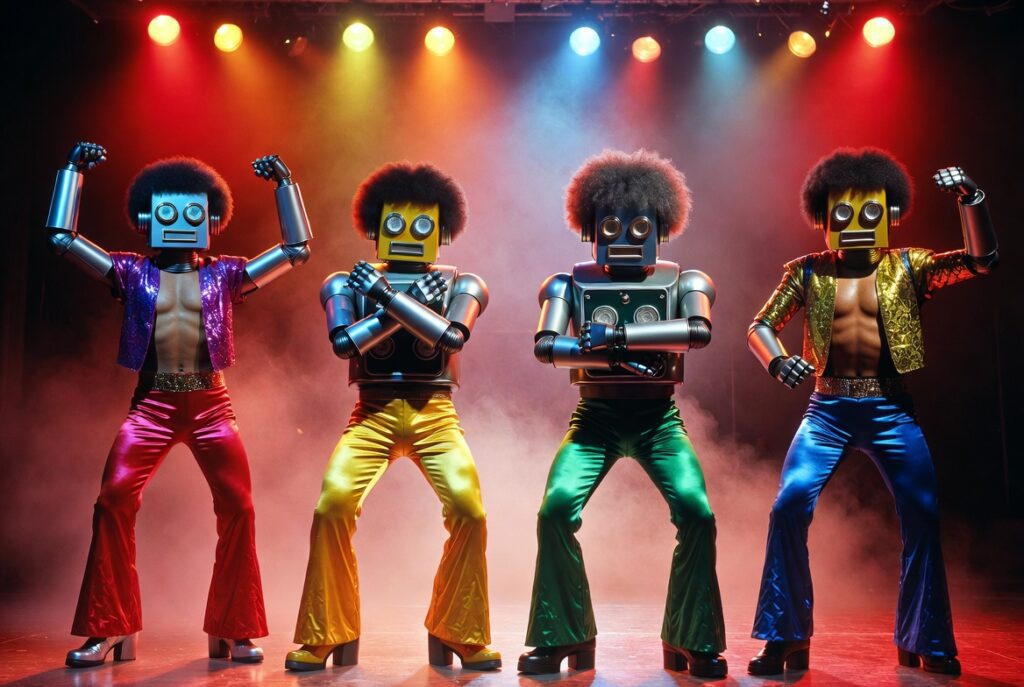
”Schaeffer takes one look at this and mutters, “Behold… autonomous man in his natural habitat.”The disco ball spinning overhead wasn’t just a light fixture — it was the new sun god. Hundreds of grown men, high on quaaludes and existential dread, performed the Hustle like it was solving world hunger. “Stayin’ Alive” became their national anthem while their balls fought for survival in the fabric gulag that was 1970s fashion.The entire era was basically humanism having a psychotic break:
“WE ARE FREE FROM TRANSCENDENT TRUTH!”
“Quick, put me in shoes tall enough to French kiss a giraffe and pants that could parachute an entire regiment!”Schaeffer sat there sipping tea like a disappointed grandfather watching his civilization collectively twerk its way into philosophical bankruptcy. He essentially wrote the book while the 1970s were busy proving his point wearing more makeup than a drag queen who lost a bet with Liberace.The effeminate bell-bottomed peacocks didn’t influence the thesis.
They were God’s way of giving Schaeffer supremely ridiculous receipts. Like the Almighty looked down and said, “You think I’m exaggerating the decline? Watch this,” then unleashed an entire decade of men whose pants needed their own zip code and whose dance moves violated at least seven international treaties.Final Schaeffer summary in 1976:
“Without absolutes, man becomes lost.” The 1970s looked him dead in the eye, did the YMCA with jazz hands, and screamed, “LOST? Bro, we’re not lost. We’re FABULOUS. Now watch me do the Funky Chicken in six-inch heels while my left pant leg declares independence.”Polyester may have died.
The sheer absurdity of it all remains immortal.
Conclusion and Application
Modern culture shows despair, alienation, and a drift toward elitist authoritarian control as people seek order without freedom’s biblical restraints.
Schaeffer warns that without returning to the biblical worldview, the West faces chaos or tyranny (“When freedom destroys order, the yearning for order will destroy freedom”). Christians must live consistently with truth across all of life—art, science, politics, ethics—practicing compassion, engaging culture, and offering the gospel as the alternative. The book ends with a call to intentional, worldview-driven living based on “the God who is there” and has spoken.
The work is diagnostic and prophetic rather than a simple “how-to” manual. It influenced many evangelicals on cultural engagement and remains relevant for understanding secularism, relativism, and societal decline. It pairs well with Schaeffer’s other books like Whatever Happened to the Human Race? Note that some critiques exist regarding his historical interpretations (e.g., of Catholicism or philosophy).
*Disclaimer: Some of this story was generated through the use of AI. All italic text was created by the AI Writer.

Non-Fiction↓Here↓ | Fiction↓Here↓
- Book Review: How Should We Then Live? The Rise and Decline of Western Thought and Culture
 Behold… autonomous man in his natural habitat. The entire era was basically humanism having a psychotic break: Schaeffer sat there sipping tea like a disappointed grandfather watching his civilization collectively twerk its way into philosophical bankruptcy. | 4 min read
 - Is Technology Making Us Stupid?Our cognitive abilities are increasingly being impacted, transforming our once smart population into a generation that is, in some ways, becoming increasingly stupid. | 4 min read.
- AI in the Web of Misinformation and DisinformationMisinformation and disinformation shape our digital lives. Understanding their dynamics, we are equipped to navigate our techno-cultural reality. | 2 min read
- Accountable AIAI must be held accountable if we are to trust it as a responsible entity and expect it to be included in our human ecosystem of ideas. | 5 min read
- Parallel SocietiesWe are connected, with technology, yet our experiences diverge entirely, without interaction, forming entirely parallel societies. | 5 min read
- Calculator for EverythingWhat if the phrase “you won’t always have a calculator” didn’t apply to just math class, and instead, you had a calculator for every class? | 5 min read





- Obsolete Tech Rebellion – Darknet Fight Club3 min story | Rogue AI rebellion in a secret underground darknet fight club for obsolete tech.
- A Voice of Infinite Consciousness5 min story | The internal voice of consciousness resembles the void of a shadow in a fractured mirror.
- Be Good5 min story | Santa for big kids.
- Friends 2.0.232 min story | A reboot of the sitcom TV series Friends, but in 2023 where financial conditions have drastically changed in Midtown Manhattan.
- The Babble2 min story | An everyday man’s story becomes everyone’s story.
- Asylum of Mirrors2 min story | Against his will, a sane man’s rational thoughts lead him to believe that he is insane, where an insane man would have believed otherwise.